


RIFM advances respiratory sensitizers’ screening
10.5.26
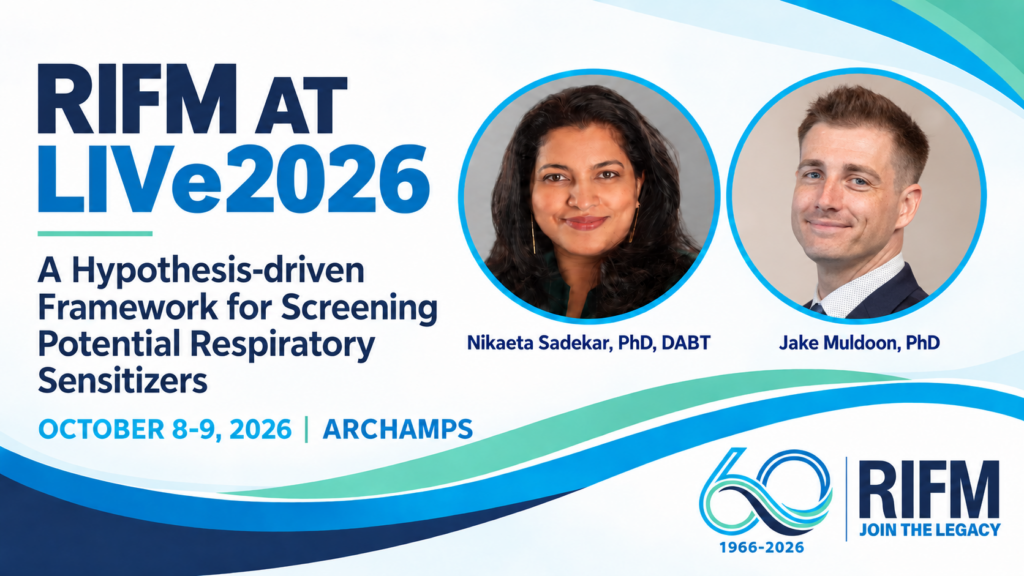
Research Institute for Fragrance Materials (RIFM) scientists Nikaeta Sadekar, PhD, DABT, and Jake Muldoon, PhD, will share a hypothesis-driven framework for screening potential respiratory sensitizers at the LIVe2026 Congress, taking place October 8-9 in Archamps, France.
(LIVe stands for Lung In Vitro event.)
Drs. Sadekar, Principal Scientist & Supervisor, Scientific Education & Impact, and Muldoon, Scientist, Chemistry, will present the research during Session 1, Inhalation Toxicity Testing, on Thursday, October 8 at 10:10 AM local time.
The study evaluated the chemical reactivity and clinical characteristics of known respiratory sensitizers in comparison with skin sensitizers and non-sensitizing irritants. The researchers combined clinical case reviews with TIMES in silico modeling to examine whether the groups showed distinct reactivity patterns.
The findings indicate that respiratory sensitizers are frequently associated with bifunctional electrophilic structures that can cross-link proteins in respiratory tissues. Skin sensitizers and irritants are generally more readily detoxified and excreted. This mechanistic distinction supports the development of predictive approaches for identifying substances that may warrant closer evaluation for respiratory sensitization.
“Validated methods designed specifically to identify respiratory sensitizers are still lacking, so the field needs approaches that make the best use of the evidence we have,” Dr. Sadekar explained. “By bringing chemical reactivity, clinical findings, and in silico modeling together, this framework gives us a scientifically grounded way to prioritize substances for further evaluation and advance non-animal assessment.”
“Our analysis points to a mechanistic distinction that can help focus future research,” Dr. Muldoon added. “I am looking forward to discussing the framework with scientists working on predictive respiratory models and identifying opportunities to test and strengthen it through collaboration.”
LIVe2026 brings together scientists, industry professionals, and regulatory stakeholders working to advance human-relevant in vitro respiratory research. The congress will address predictive lung models, inhalation toxicity testing, regulatory considerations, exposure modeling, and related areas of respiratory science.