


Holger Moustakas, PhD, will share how composition-based hierarchical clustering can support read-across and more efficient fragrance safety assessment.
8.19.26
The Research Institute for Fragrance Materials (RIFM) will present new research at ACS Fall 2026 demonstrating how agglomerative hierarchical clustering (AHC) can be used to organize natural complex substances (NCS) into scientifically meaningful groups for non-animal safety assessment.
ACS Fall 2026 will take place August 23-27 at McCormick Place in Chicago and online. RIFM Senior Scientist Holger Moustakas, PhD, will deliver “Chemical Clustering of Natural Complex Substance (NCS) Materials: A Hierarchical Clustering Approach for Use in Non-Animal Safety Assessments” during the Hot Topics in Chemical Toxicology session on Thursday, August 27, from 11:25 to 11:45 a.m. EDT (10:25 to 10:45 a.m. CDT).
A composition-first approach to complex mixtures
Unlike discrete substances, NCS materials comprise many constituents whose relative proportions can vary. That complexity makes them difficult to organize with a single descriptor, such as a botanical genus.
The study evaluated 166 NCS materials representing more than 20 botanical families and over 30 genera. The AHC results showed that the materials could not be grouped reliably by genus alone; in some cases, materials from different genera clustered together based on their compositions. Restricting the analysis to constituents representing 80%, 85%, or 90% of each material’s total composition produced minimal to no changes in the clusters, suggesting that the groupings were stable across the evaluated thresholds.
The composition-informed approach could help scientists prioritize data analysis and identify potential read-across analogs. Read-across uses data from sufficiently similar substances to inform the safety assessment of a material with limited data; each proposed analog still requires scientific evaluation within the full weight of evidence.
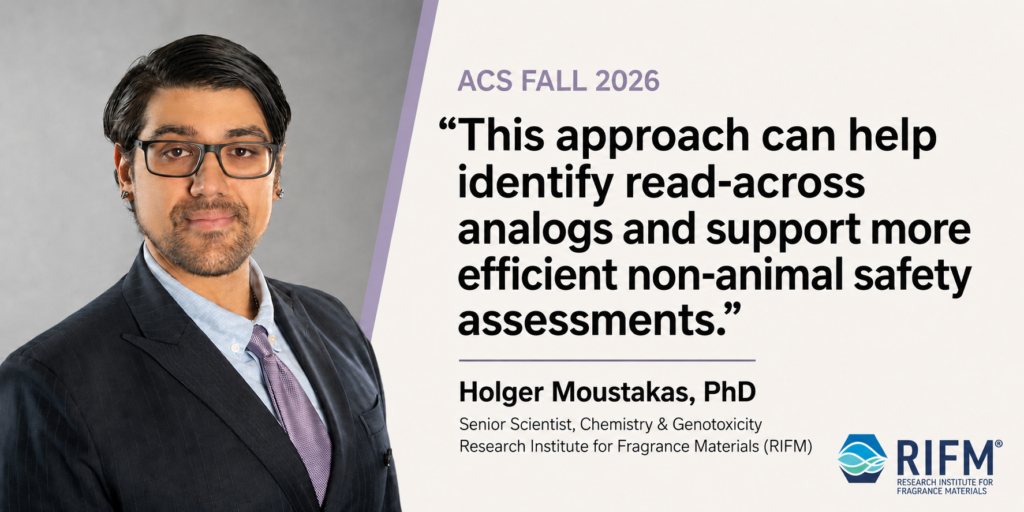
“This approach can help identify read-across analogs and support more efficient non-animal safety assessments,” Dr. Moustakas explained.
Advancing transparent, non-animal safety science
The research aligns with RIFM’s commitment to non-animal approaches for human health endpoints and its emphasis on high-quality existing data and modeling. By grounding the clusters in chemical composition rather than botanical naming alone, the method is designed to make grouping decisions easier to explain, reproduce, and evaluate.
RIFM President Anne Marie Api, PhD, Fellow ATS, emphasized the value of presenting the research to the wider scientific community. “Sharing this work at ACS helps strengthen confidence in transparent, non-animal safety science,” Dr. Api said.
The ACS Fall 2026 hybrid program brings together researchers and industry leaders to share new science and build collaborations. For meeting details and registration, visit ACS Fall 2026.