


RIFM brings exposure science to ISES 2026
9.25.26
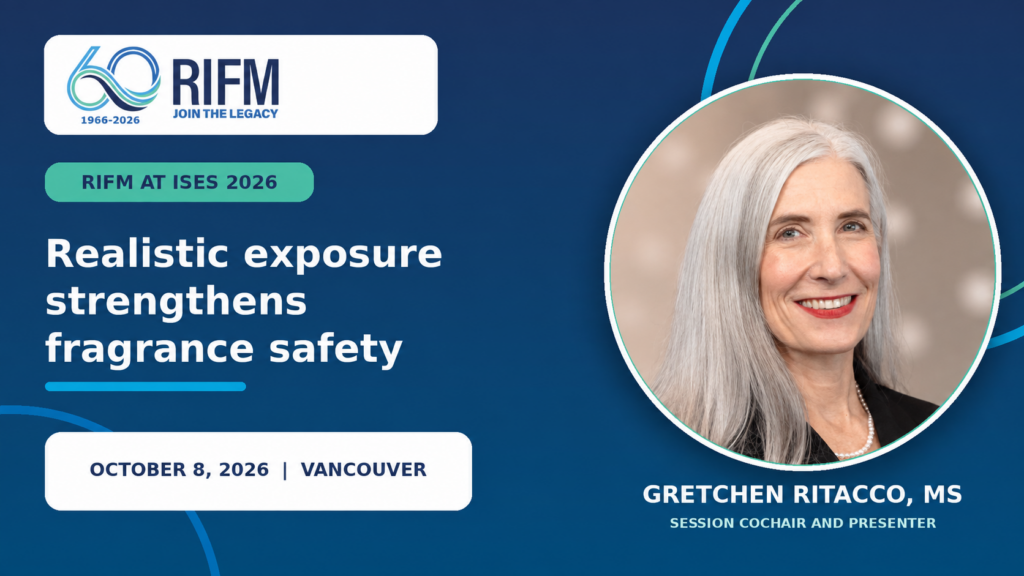
Gretchen Ritacco, MS, Manager, Scientific Operations & Exposure Modeling for the Research Institute for Fragrance Materials, will cochair a session and present RIFM’s work on realistic consumer exposure at the International Society of Exposure Science Annual Meeting in Vancouver, Canada. The meeting takes place October 4-8, 2026, at the Sheraton Vancouver Wall Centre.
On Thursday, October 8, Ritacco and Cesar Scrochi of Creme Global will cochair the session “Human Exposure Factors and Behavior.” At 11:45 a.m. local time, Ritacco will present “A Probabilistic Aggregate Exposure Model Provides Realistic Exposure Data and Is at the Foundation of Fragrance Safety Assessments.”
Accurate exposure estimates are essential to determining whether a fragrance ingredient can be used safely. RIFM and Creme Global developed the Creme RIFM Aggregate Exposure Model to calculate aggregate exposure across personal care, household, oral care, and air care products. The model combines fragrance concentration data supplied by fragrance compounders and consumer product companies with real-world diaries describing product use. It estimates exposure through oral, dermal, and inhalation routes.
RIFM’s safety assessments use the model’s 95th-percentile exposure estimate, which represents the upper end of expected use and is consistent with loyal users of fragranced products. Periodic concentration surveys, conducted at least every five years, keep the model current. Its flexible design has also allowed RIFM and Crème Global to add geographic habits and practices data, new product types, and data specific to baby products and their use.
A recent analysis of aggregate exposure data for more than 3,000 fragrance ingredients currently in use found that consumer exposure is typically orders of magnitude below safe use levels. Presenting the approach at ISES gives exposure scientists from academia, government, and industry an opportunity to examine the methods and discuss how to continue improving them.
“Exposure is what connects a fragrance ingredient’s hazard data to its real-world use,” Ms. Ritacco said. “Sharing this work at ISES gives us an important opportunity to test our methods with the wider exposure science community and show how better exposure estimates support decisions that are both protective and grounded in how products are actually used. That benefits RIFM members and everyone who relies on rigorous fragrance safety science.”
For RIFM members, the model provides the exposure information needed to support efficient, scientifically sound safety assessments across thousands of fragrance ingredients. For regulators, researchers, and other fragrance safety stakeholders, it demonstrates how current concentration data and consumer behavior can be combined to place hazard findings in a realistic risk context.
Event information: International Society of Exposure Science Annual Meeting 2026