


RIFM scientists to present human-relevant fragrance safety research at EUROTOX 2026
9.8.26
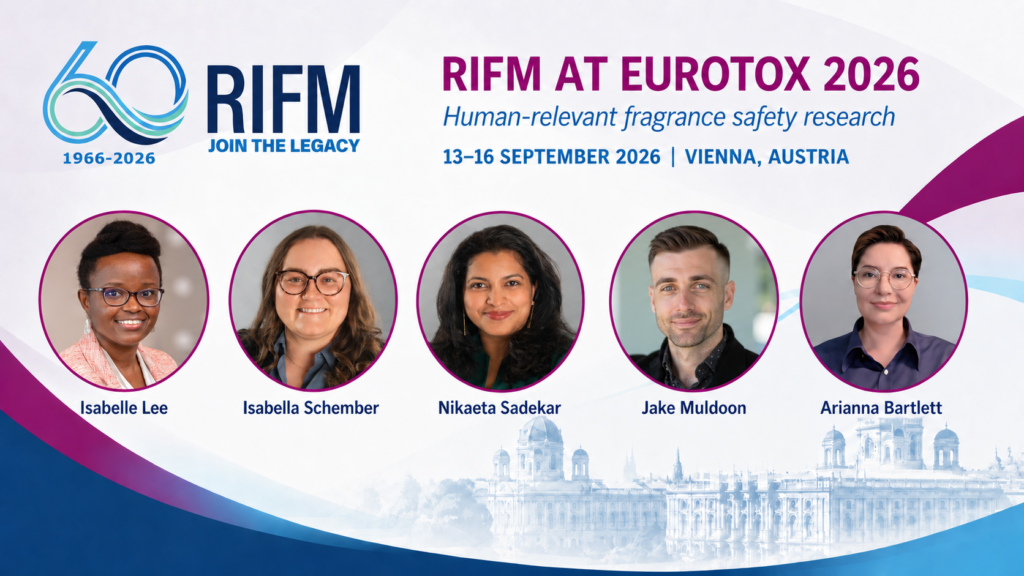
RIFM scientists will share six contributions at EUROTOX 2026, the 60th Congress of the European Societies of Toxicology, taking place September 13-16 in Vienna, Austria. This year marks a shared milestone, as both RIFM and EUROTOX celebrate their 60th anniversaries. In recognition of this shared milestone, RIFM will sponsor the Monday lunch session.
Through one industry-hosted presentation and five posters, RIFM and its research collaborators will share work advancing human-relevant fragrance safety assessment. The research addresses skin and respiratory sensitization, endpoint-specific read-across for genotoxicity, natural complex substances (NCS), non-animal methods, and the importance of evaluating toxicological findings in the context of realistic consumer exposure.
All six RIFM contributions will be presented on Tuesday, September 15.
Industry-hosted presentation
Case study of GARD®skin Dose-Response on Natural Extracts and Quantitative Risk Assessment
Presented by Isabelle Lee, PhD, Manager, Human Health Science & Strategy, during the SenzaGen Industry Hosted Session from 12:15 to 1:15 PM CEST in Hall M.
The presentation will demonstrate how points of departure predicted using GARDskin Dose-Response can be applied within a next-generation risk assessment framework for NCS. These substances, including botanical extracts and essential oils, can pose assessment challenges when their composition varies or when a component-based analysis cannot be completed.
“NCS materials present unique challenges for skin sensitization assessment because their composition can vary and component-based approaches are not always sufficient,” Dr. Lee explained. “Presenting this case study at EUROTOX gives us an important opportunity to demonstrate how GARDskin Dose-Response can provide quantitative information for risk assessment and to discuss its application with the broader toxicology community.”
Poster presentations
Poster Viewing 2 and the September 15 lunch and coffee breaks.
P21-13: Application of the GARDskin Dose-Response Assay to Natural Complex Substances in Fragrance Ingredient Safety Assessment
Presented by Dr. Lee, this study evaluated the GARDskin Dose-Response assay as a new approach to estimating the skin-sensitization potency of 11 fragrance NCS ingredients. The findings support its potential use in quantitative risk assessment and in reducing reliance on animal testing when component-based approaches are not sufficient.
P30-28: Assessing the performance of the SARA-ICE defined approach in fragrance ingredient point of departure prediction
Presented by Isabella Schember, PhD, Scientist, Dermatotoxicology, this research evaluates SARA-ICE, a non-animal defined approach that integrates data from New Approach Methodologies to predict skin sensitization points of departure for fragrance ingredients. Predicted and reference points of departure showed a strong correlation across a diverse fragrance dataset, with predictions generally remaining conservative and protective.
“This work shows how integrated in vitro data can be used to predict points of departure that support fragrance safety assessment without relying on new animal studies,” Dr. Schember said. “EUROTOX is an ideal forum for sharing these findings because it brings together scientists and regulators working to advance practical, human-relevant approaches to skin sensitization risk assessment.”
P29-08: A Hypothesis-driven Framework for Screening of Potential Respiratory Sensitizers
Presented by Nikaeta Sadekar, PhD, DABT, Principal Scientist & Supervisor, Scientific Education & Impact, and developed with RIFM scientists Jake Muldoon, PhD, Scientist, Chemistry, and Danielle Botelho, PhD, Director of Scientific Operations, and external collaborators.
The researchers combined clinical case reviews with in silico modeling to compare respiratory sensitizers, skin sensitizers, and non-sensitizing irritants. The findings indicate that respiratory sensitizers are frequently associated with bifunctional electrophilic structures capable of cross-linking proteins in respiratory tissues. This mechanistic insight supports the development of more predictive approaches for identifying potential respiratory sensitizers.
“Respiratory sensitization remains a challenging area because validated methods for specifically identifying respiratory sensitizers do not yet exist,” Dr. Sadekar explained. “Presenting this hypothesis-driven framework at EUROTOX allows us to show how mechanistic insights, clinical evidence, and in silico modeling can be integrated to improve screening and to encourage the scientific collaboration needed to move this field forward.”
P-30-37: Endpoint-Specific Guidance for Read-Across Using RIFM Structure Activity Groups: Application to Genotoxicity and Skin Sensitization
Presented by Jake Muldoon, PhD, Scientist, Chemistry, this research will provide new guidance on selecting chemical analogs for non-animal safety assessments. Read-across, using data from a well-studied chemical to fill gaps for a similar one, depends on choosing the right analog, with conventional methods relying on overall structural similarity. The RIFM framework introduces 139 endpoint-specific rules that instead focus on the structural features responsible for driving reactivity in genotoxicity and skin sensitization. Coupled with RIFM’s latest chemical grouping methodology, this framework allows for transparent and explainable defense of read-across analog selection.
“Two chemicals can look almost identical and behave differently,” Dr. Muldoon said. “These endpoint rules explicitly show what matters: the structural features driving genotoxicity and skin sensitization. EUROTOX is a great venue for this work because RIFM’s read-across process is transparent and explainable. It allows for constructive dialogue between chemists, toxicologists, and regulators.”
P26-03: Bridging Experimental Toxicity and Exposure Modeling in Fragrance Safety: Case Studies on Human Health Relevance
Presented by Arianna Bartlett, PhD, Senior Associate Scientist, Repeated Dose and Reproductive Toxicology.
Using case studies of 12 fragrance materials, this poster illustrates the difference between hazard-derived doses and realistic consumer exposure. It shows how integrating toxicology with probabilistic exposure modeling can provide meaningful context for interpreting human health risk.
“I’m excited to share this work because it highlights the importance of putting toxicological findings into a real-world context,” Dr. Bartlett said. “Through twelve fragrance case studies, we demonstrate how integrating hazard data with realistic exposure estimates can improve both scientific understanding and risk communication.”
Together, these contributions reflect RIFM’s commitment to scientifically sound, human-relevant methods that place hazard in the context of exposure and advance reliable non-animal approaches to fragrance safety.